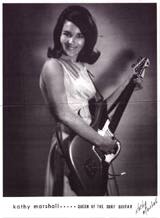
 During the heyday of surf instrumental music in the sixties, there was a now-legendary Queen of
the Surf Guitar. She was a 13 year old girl named Kathy Marshall. She didn't have her own
band, but she did sit in with several of the top bands of the day. Kathy was a frequent "member" of
surf legends Eddie and the Showmen, the Blazers, and the Crossfires (who later
became the Turtles). There were no releases with her guitar on them (only two unheard acetates
exist that I know of), but her double picking talent made quite a stir in those days. Her on-stage
rivalry with Eddie Bertrand was a major draw during Eddie and the Showmen's peak year
as house band at the Retail Clerk's Hall in 1964. Kathy was managed by Bert Bertrand,
Eddie's father.
During the heyday of surf instrumental music in the sixties, there was a now-legendary Queen of
the Surf Guitar. She was a 13 year old girl named Kathy Marshall. She didn't have her own
band, but she did sit in with several of the top bands of the day. Kathy was a frequent "member" of
surf legends Eddie and the Showmen, the Blazers, and the Crossfires (who later
became the Turtles). There were no releases with her guitar on them (only two unheard acetates
exist that I know of), but her double picking talent made quite a stir in those days. Her on-stage
rivalry with Eddie Bertrand was a major draw during Eddie and the Showmen's peak year
as house band at the Retail Clerk's Hall in 1964. Kathy was managed by Bert Bertrand,
Eddie's father.
Once, Kathy even played with Dick Dale. He introduced her, and then she broke into "The Wedge." Her fire caused him to first step back and watch, then take off his guitar and stare, then finally throw up his hands and walk off stage. Dick didn't like being upstaged. He got over it quickly, as he does.
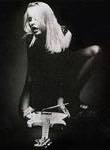 Why is this important? During the early-mid sixties, while the surf guitar was thee sound, Kathy
Marshall was the celebrated exception. She was rightly recognized for her talent, but it was the
fact that she was a girl and could show up the boys that earned her the big buzz.
Why is this important? During the early-mid sixties, while the surf guitar was thee sound, Kathy
Marshall was the celebrated exception. She was rightly recognized for her talent, but it was the
fact that she was a girl and could show up the boys that earned her the big buzz.
In 1964, the civil rights movement was underway, though it was mostly focused in the South. Aside from reading about the suffragettes in high school history, females were still mostly at home. In music, they were primarily involved in the "hit machine" side of the business as vocal instruments in the hands of the producer. It's not that there hadn't been incredibly good women playing rock guitar before, but most were not credited on the records, and most fans were too young to go to the rock shows where occasionally one would be in the band. From the beginning, women had been contributing to the legend and magic of the electric guitar.
Every musicologist draws his own lines in the sand when talking about the evolution of the various genres. In rock 'n' roll, some ignore the differences between RandB and rock 'n' roll and go back to the twenties, but most hover somewhere around the early fifties. For me, the obvious demarcation line is drawn by the emergence of Bo Diddley. Bo's great and innovative use of the electric guitar set him apart from the rest. Bo Diddley used women as rhythm guitarists on and off for many years. The Duchess and Lady Bo played on stage with Bo, and were session players on his hits as well. Lady Bo is still quite active, and is an incredible player. She lives just down the road from me in Boulder Creek, California. The trouble is, Peggy "Lady Bo" Malone was not credited on any of Bo's releases while he was on the Chess/Checker label, even though she played on many of the hit sessions. It wasn't the practice to list the players in those days, so there was nothing sinister about the omission. You might see Jerome Green's name, but you'd never see the names of the legendary Chess session men like Willie Dixon listed on the sleeve.
As a lad, I saw things in terms of fair and unfair. At first, this was defined solely in terms of me. It was unfair that I couldn't do this or go there. Later, I redefined it in terms of rights, driven by whether it would mean I could be free do this or go there. Gradually, I saw things in terms of equal outcome because it could be related to whether I could be guaranteed the ability to do this or go there. This allowed me to buy into the evolving equality arguments that were being morphed from Martin Luther King's vision of equal opportunity to the argument for equal outcome.
 It would be many years before my father's advice would sink in. He would say "Nobody owes you
a living! Go out and get a job. Earn your way. Only you can take advantage of the opportunities presented
to you." He echoed the words of Bay Area talk show legend Doug Pledger who closed every
show with "Opportunity Knocks. You have to open the door."
It would be many years before my father's advice would sink in. He would say "Nobody owes you
a living! Go out and get a job. Earn your way. Only you can take advantage of the opportunities presented
to you." He echoed the words of Bay Area talk show legend Doug Pledger who closed every
show with "Opportunity Knocks. You have to open the door."
I didn't understand this for a very long time, but as life requires this perspective anyway, I had no choice but to perform or be passed over. My obsession with not being poor coupled with my analytical skill were often manifested in ways that my bosses saw as leadership qualities. Once the adolescent hormone battle ended, I was recognized and promoted in nearly every job I held.
 Many years would pass before I was able to look at the difference between my position and that of
others in terms of what I was doing that they were not doing. It was a silly line spoken by some get
rich quick motivational snake oil salesman that caused my vision to finally clear. I don't even remember
who he was, but the line was something like "study what poor people do, and DON'T do that. Study
what rich people do, and DO that." Until then, I held the belief that anyone who didn't achieve
was a victim. Someone was stopping them. I didn't realize that the some one might well have been them.
I didn't want to accept that I might be holding me back.
Many years would pass before I was able to look at the difference between my position and that of
others in terms of what I was doing that they were not doing. It was a silly line spoken by some get
rich quick motivational snake oil salesman that caused my vision to finally clear. I don't even remember
who he was, but the line was something like "study what poor people do, and DON'T do that. Study
what rich people do, and DO that." Until then, I held the belief that anyone who didn't achieve
was a victim. Someone was stopping them. I didn't realize that the some one might well have been them.
I didn't want to accept that I might be holding me back.
Kathy Marshall was a sensation on the live circuit in Southern California because she had three qualities. The first was skill. The second was courage. The third was opportunity. This is the order they always come in. First, we need to develop a skill some one else will pay for. Second, we have to display it so they know we have it. Then, opportunities are poresented. This is where Doug Pledger's words come in. Opportunities are worthless if we don't grab them. No risk, no gain. We have to take the risk. No one else can.
There is an even larger factor, however, affecting the small number of great women guitarists. Often left out of the philosophical arguments over equal opportunity vs. equal outcome, this factor looms larger than all others, and when stated, often is received with either disbelief or the heated emotional tirades that paradigm busters often get. That factor put politely is interest. More correctly, it is the natural tendency for some kinds of activities and behaviors to interest girls more than boys, and vice versa. It is the "natural" part that is the rub in the politically correct world of equal outcome.
 Disregard the rhetoric about girls can do anything boys can do. It's not about ability. Of course
they CAN if they want to. There's no evidence that women can't rock. On the contrary, I've
already cited several wonderful examples of female guitarist with real power and flair. It's about
want to, and about style. It's about wanting to play guitar, and then about wanting to play high powered
double picked leads. Now before you go off and decide I'm some kind of woman hater or chauvinist cretin,
think about what you see every where you look in nature.
Disregard the rhetoric about girls can do anything boys can do. It's not about ability. Of course
they CAN if they want to. There's no evidence that women can't rock. On the contrary, I've
already cited several wonderful examples of female guitarist with real power and flair. It's about
want to, and about style. It's about wanting to play guitar, and then about wanting to play high powered
double picked leads. Now before you go off and decide I'm some kind of woman hater or chauvinist cretin,
think about what you see every where you look in nature.
It's the peacock effect. In the natural world, the differences between male and female is most easily illustrated in those aspects of behavior present in the mating rituals. It is the male of most species that is brightly colored, largely plumed, wildly maned, and flamboyantly adorned. The male must get the attention of the female, not the other way around.
Male animals perform with feathers, dances, moves, gifts, singing, and displays of all kinds. Humans aren't any different. Men dominate the arts because it is an extension of the peacock effect. They are doing stylized mating displays.
Look at what happens to men who perform. They get the girls! It's as simple as that. The reason we can believe in equal opportunity, and I absolutely do, and still find female accomplishment in some arenas to be a novelty is because it is so rare. Certainly in the arena of rock guitar, there are precious few examples of female players who "rock." Kathy Marshall, Lady Bo, April Lawton of Ramatam, Susan Yasinksi of Susan and the SurfTones, and Elka Zolot of the Trashwomen. I'm differentiating between loud or aggressive playing and pure power center stage lead guitar prowess. There just aren't many women who play like this.
Men love the paradox of a great women player, particularly when they can play like hell and retain the feminine subtlety of the instrument at the same time. Men buy the vast majority of the music sold. There's no shortage of opportunity, just a lack of interest.
There are many fine guitar playing women, but their styles of playing are generally more accompaniment than lead, and their approach to the instrument is more about composition than leadership or power.
At the end of the day, there's just no difference between the guitar, the amp, the studio, the sound stage, or the CD stamping house. There's only differences in interest standing between the boys and the girls.
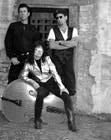 I am struck by how many more female rhythm guitarists and bass players there are than lead guitarists.
The Cadillac Angels' Mickey Rae is as good a bassist as they come, and certainly more
fascinating to watch than Noel Redding. Her style and energy are every bit as perfect and magnetic
as Nathan String Bing (the Ultras). Even rarer than lady lead guitarists are women drummers.
Women just don't seem to want to beat things with stick to make loud noise. The warrior scream just
isn't in most of them.
I am struck by how many more female rhythm guitarists and bass players there are than lead guitarists.
The Cadillac Angels' Mickey Rae is as good a bassist as they come, and certainly more
fascinating to watch than Noel Redding. Her style and energy are every bit as perfect and magnetic
as Nathan String Bing (the Ultras). Even rarer than lady lead guitarists are women drummers.
Women just don't seem to want to beat things with stick to make loud noise. The warrior scream just
isn't in most of them.
I have a dear friend that sees the good old boys network everywhere as the biggest obstacle between her and a faster rise up the corporate ladder. I see it quite differently. After many years of watching women behave in the workplace, the single most common difference I see between those who succeed and those who don't is their own behavior, not their gender.
 The lie perpetrated by the equal outcome proponents is that business people are willing to sacrifice
their profit potential just to keep women down. First, many businesses are women owned, and the results
there are only different when women discriminate against men. But, more importantly, as any business
person will tell you, this is all utter nonsense in most cases. The better the performance, the better
the results. Sex has nothing to do with it. I'm not overlooking the nimrod exceptions that abuse their
position or promote via the casting couch. Those people exist, both male and female. They are not
in the majority.
The lie perpetrated by the equal outcome proponents is that business people are willing to sacrifice
their profit potential just to keep women down. First, many businesses are women owned, and the results
there are only different when women discriminate against men. But, more importantly, as any business
person will tell you, this is all utter nonsense in most cases. The better the performance, the better
the results. Sex has nothing to do with it. I'm not overlooking the nimrod exceptions that abuse their
position or promote via the casting couch. Those people exist, both male and female. They are not
in the majority.
There's a woman I know that has had several opportunities over the past few years where she works to be in the "acting" role due to the departure of her immediate boss and functional executive. She has been passed over for promotion each time, and will again. She keeps getting the opportunity because she has a lot of talent and respect among her peers, and a lot of recognition by the executives. What she lacks is demonstrating she is ready for the move. At some point, if she doesn't rise to the occasion, she will no longer be afforded the opportunity to even try out. She will see it as discrimination. I see it as her performance. She hasn't learned to see the big enough picture, and she hasn't learned how to properly defer to the boss, and how to constructively disagree.
She too often gets miffed when her presentation to the executives causes a discussion she didn't plan, and she lets the CEO see she didn't like his having that conversation. I see his actions as a compliment to her, because they display his interest in her subject, and they validate the importance of the data she alone brought to their attention. Her presentation was powerful. She sees it as disruptive and disrespectful of her. If she can't get over this petty view, she will not rise above her present level, and worse yet, opportunities will stop coming her way. She is convinced she is ignored because she is a women. I'm convinced she is taken very seriously by the executives who keep giving her the opportunity to be in the acting role because she is good at what she does and gets things done. It is her behavior that demonstrates she doesn't understand the power of her vision, or how to use it. She is thinking small and wondering why she is not advancing. It's her fault, not theirs.
The company environment certainly does not restrict female roles. There are many female senior executives in the parent company overseeing what happens where she works. Major technical and management players are women. She hasn't taken best advantage of the opportunity because she thinks in equal outcome terms.
 All this adds up to differences between the sexes in how they see things, and much of it has nothing
to do with programming by parents. Barbie didn't ruin women's lives. Men don't pass women over
for promotion just because they are women, not if they want to stay competitive. Men certainly don't
keep women from playing great lead guitar. There just aren't many who want to. That's not bad, or
good. It just is.
All this adds up to differences between the sexes in how they see things, and much of it has nothing
to do with programming by parents. Barbie didn't ruin women's lives. Men don't pass women over
for promotion just because they are women, not if they want to stay competitive. Men certainly don't
keep women from playing great lead guitar. There just aren't many who want to. That's not bad, or
good. It just is.
If you ever actually see discrimination, fight it to the death. It's just plain wrong. But, before you go do battle, first be sure the result wouldn't be the same for a male using the same behavior.
As in most areas of life, music reflects what is really happening, not in lyrical content, but in style and roles, in success and failure, and in interest and ability. Revel in the freedom to risk, to try and to fail. No risk, no gain.
 What brought this to my soap box this month is the in depth interview I did with Susan Yasinski of Susan
and the SurfTones. Her skill is excellent, and her drive is apparent in all areas of her life.
She is a fine surf guitarist, and also a lawyer, but mostly a person. I was drawn to her by her music,
and then realized the rarity of her role as lead guitarist, especially in a trio situation. She does
legal work to defend the little guy. She is a warrior. She is also a woman. That is secondary to her
ability to pay her role. She chose the role. She learned to play guitar. She went to law school. She
opened the door.
What brought this to my soap box this month is the in depth interview I did with Susan Yasinski of Susan
and the SurfTones. Her skill is excellent, and her drive is apparent in all areas of her life.
She is a fine surf guitarist, and also a lawyer, but mostly a person. I was drawn to her by her music,
and then realized the rarity of her role as lead guitarist, especially in a trio situation. She does
legal work to defend the little guy. She is a warrior. She is also a woman. That is secondary to her
ability to pay her role. She chose the role. She learned to play guitar. She went to law school. She
opened the door.
© 2005 Phil Dirt
Some of the information in this column was culled from Robert Dalley's book, Surfin' Guitars: Instrumental Surf Bands of The Sixties, © 1988.